The AI Singularity is Dead; Long Live the Cybernetic Singularity - Science Not Fiction : Science Not Fiction


The AI Singularity is Dead; Long Live the Cybernetic Singularity

The nerd echo chamber is reverberating this week with the furious debate over Charlie Stross' doubts about the possibility of an artificial "human-level intelligence" explosion – also known as the Singularity. As currently defined, the Singularity will be an event in the future in which artificial intelligence reaches human level intelligence. At that point, the AI (i.e. AI n) will reflexively begin to improve itself and build AI's more intelligent than itself (i.e. AI n+1) which will result in an exponential explosion of intelligence towards near deity levels of super-intelligent AI After reading over the debates, I've come to a conclusion that both sides miss a critical element of the Singularity discussion: the human beings. Putting people back into the picture allows for a vision of the Singularity that simultaneously addresses several philosophical quandaries. To get there, however, we must first re-trace the steps of the current debate.

I've already made my case for why I'm not too concerned, but it's always fun to see what fantastic fulminations are being exchanged over our future AI overlords. Sparking the flames this time around is Charlie Stross, who knows a thing or two about the Singularity and futuristic speculation. It's the kind of thing this blog exists to cover: a science fiction author tackling the rational scientific possibility of something about which he has written. Stross argues in a post entitled "Three arguments against the singularity" that "In short: Santa Clause doesn't exist."

This is my take on the singularity: we're not going to see a hard take-off, or a slow take-off, or any kind of AI-mediated exponential outburst. What we're going to see is increasingly solicitous machines defining our environment — machines that sense and respond to our needs "intelligently". But it will be the intelligence of the serving hand rather than the commanding brain, and we're only at risk of disaster if we harbour self-destructive impulses.

We may eventually see mind uploading, but there'll be a holy war to end holy wars before it becomes widespread: it will literally overturn religions. That would be a singular event, but beyond giving us an opportunity to run [Robert] Nozick's experience machine thought experiment for real, I'm not sure we'd be able to make effective use of it — our hard-wired biophilia will keep dragging us back to the real world, or to simulations indistinguishable from it.

I am thankful that many of the fine readers of Science Not Fiction are avowed skeptics and raise a wary eyebrow to discussions of the Singularity. Given his stature in the science fiction and speculative science community, Stross' comments elicited quite an uproar. Those who are believers (and it is a kind of faith, regardless of how much Bayesian analysis one does) in the Rapture of the Nerds have two holy grails which Stross unceremoniously dismissed: the rise of super-intelligent AI and mind uploading. As a result, a few commentators on emerging technologies squared off for another round of speculative slap fights. In one corner, we have Singularitarians Michael Anissimov of the Singularity Institute for Artificial Intelligence and AI researcher Ben Goertzel. In the other, we have the excellent Alex Knapp of Forbes' Robot Overlords and the brutally rational George Mason University (my alma mater) economist and Oxford Future of Humanity Institute contributor Robin Hanson. I'll spare you all the back and forth (and all of Goertzel's infuriating emoticons) and cut to the point being debated. To paraphrase and summarize, the argument is as follows:

1. Stross' point: Human intelligence has three characteristics: embodiment, self-interest, and evolutionary emergence. AI will not/cannot/should not mirror human intelligence.

2. Singularitarian response: Anissimov and Goertzel argue that human-level general intelligence need not function or arise the way human intelligence has. With sufficient research and devotion to Saint Bayes, super-intelligent friendly AI is probable.

3. Skeptic rebuttal: Hanson argues A) "Intelligence" is a nebulous catch-all like "betterness" that is ill-defined. The ambiguity of the word renders the claims of Singularitarians difficult/impossible to disprove (i.e. special pleading); Knapp argues B) Computers and AI are excellent at specific types of thinking and augmenting human thought (i.e. Kasparov's Advanced Chess). Even if one grants that AI could reach human or beyond human level, the nature of that intelligence would be neither independent nor self-motivated nor sufficiently well-rounded and, as a result, "bootstrapping" intelligence explosions would not happen as Singularitarian's foresee.

In essence, the debate is that "human intelligence is like this, AI is like that, never the twain shall meet. But can they parallel one another?" The premise is false, resulting in a useless question. So what we need is a new premise. Here is what I propose instead: the Singularity will be the result of a convergence and connection of human intelligence and artificial intelligence.

Intelligence is extremely hard to define. For the sake of discussion, I'll define it here as the "ability to analyze a situation, determine a problem, develop a solution, and execute." As Knapp's example of Kasparov's Advanced Chess illustrates, humans and computers are much better than one another at specific elements of chess. A computer is significantly more intelligent when it comes to chess tactics. A human is significantly more intelligent when it comes to strategy. Extrapolation of this analogy (as well as Knapp's analysis of Watson on Jeopardy!) points towards a human intelligence superiority around abstraction, invention, creativity, and imagination and a computer intelligence superiority in calculation, data analysis, and information retrieval. Thus, I propose a new analogy for the two types of intelligence represented by humans and computers: the right and left hemispheres of the human brain.

It is often said that humans are the animal that can reason. But that description is incomplete. Humans are the animal that can reason creatively and abstractly, or perform the inverse, imagine logically and rationally. To my knowledge (I'd love to be corrected) computers and AI algorithms cannot at this point in time replicate any form of right-brain thinking. But computers are orders of magnitude better at short-term, sharp-focus left-brain thinking. Combine this line of thought with the extended brain hypothesis of Andy Clark and the augmentation-based Singularity survival strategy of David Chalmers, and picture of a cybernetic future begins to emerge. Thus, I argue the Singularity should be re-imagined as a cybernetic process in which the human mind is progressively augmented with better and more complimentary artificial left-brain capacities.

As Advanced Chess demonstrates, a human with a computer is far superior to either a human alone or a computer alone. Consider the analogy of Geordi La Forge and the USS Enterprise computer being comparable with Data. Through the Enterprise, Geordi has access to the same vast processing power Data possesses, but also his own creative and inventive capacities that the Enterprise alone cannot mirror. Data's most "human" moments are when he expresses these right-brain tendencies and are, in fact, what are referenced when defending Data's personhood. It is what makes him unique and impossible to replicate with ease.

At our current state of technology, smartphones represent the most advanced and prolific form of cybernetic left-brain augmentation. These hand-held exobrains allow us to perform a multitude of processes and recall or access tremendous amounts of information through visual and auditory interfaces. As neuro-interface technology improves (hat tip Greg Fish) the information on the internet and stored in our external brains will become more expansive and more intimately connected with our nervous systems. The steps toward the Singularity will not be progressive improvement of general AI but of the gradual blending of the biological wetware of the human brain with the artificial hardware of computer technology. The Singularity will be the perfection of the mind-computer interface, such that where the mental processes of the human right-brain ends and the high-powered computer left-brain ends will be indistinguishable both externally by objective observation and internally by the subjective experience of the individual. I call this event the Cybernetic Singularity.

The Cybernetic Singularity differs from the AI Singularity in several ways and, in the process, solves several AI conundrums, both of the technological and philosophical variety.

First and foremost, the ethical "can of worms" of making pure AI is eliminated. So long as the person having his or her mind augmented grants rationally informed and deliberative consent, then no breach of ethics occurs. The concern over experimentally creating, shutting off, or restrictively programming a new form of life is eliminated.

Second, the problem of completely replicating the human mind is eliminated. Cybernetic augmentation will enhance those processes of the brain at which computers excel – memory, data analysis, and computation – without needing to replicate aspects of the brain we are barely beginning to understand, like imagination and creativity.

Third, the theological fears and philosophical qualms around uploading will be mitigated by the slow integration and blending process. Theologians can presume the "seat of the soul" rests in the right hemisphere. Because the process is gradual and the self can reflexively begin to include the augmentations into the mind's "I" construction, the worries over mind-clones and other philosophical oddities are reduced to interesting thought experiments.

Fourth, the technology is feasible. Memory stimulation, cochlear implants, bionic eyes, and haptic interfaces for prosthetics are rudimentary but empirical and existing forms of neuro-computer interfaces.

Fifth, and most relevant for fans of the apocalypse, no "hard take off" or "AI bootstrapping" will occur. In part, because the blending will be gradual as interfaces and technology incrementally improve there will be no one augmented person who is unstoppably or even significantly more "intelligent" than other augmented individuals. Also in part because there will be a human being at the center of the cyber-brain, still able to make ethical decisions and express self-interest that expands to the universal level of humanity's self-interest.

The final reason I believe the Cybernetic Singularity is more probable than the AI Singularity is simply that it makes more sense. AI's designed to do very specific tasks that are labor and data intensive make economic sense and are of obvious value, AI's designed to mirror things humans are naturally good at seems pointless. Humans have augmented our memory, our ability to calculate, and our ability to process data reliably throughout history. We've been slowly augmenting our left-hemisphere since the invention of language.

In sum, The Cybernetic Singularity is the logical extension of a process humans have been pursuing throughout history: the augmentation of our brain's computational left-hemisphere. By recognizing the relative functions of the hemispheres of the human brain, we are able to see how cybernetic augmentation of the left-hemisphere of the human brain will enable significant increases in some forms of intelligence. Pure general AI is not necessary for an intelligence increase. My theory of The Cybernetic Singularity reconciles the exponential increase in computing technology with the tremendous hurdles facing AI and overcomes the ethical, philosophical, and theological concerns around uploading and the creation of AI and/or mind uploading. The result is a human future that we can reasonably, incrementally, and ethically pursue.

Follow Kyle on his personal blog, Pop Bioethics, and on facebook and twitter.

Image via theWarehouse

Hat tip to Futurismic for many of the links.

Ъ-Газета - Владельцев ЮКОСа признали потерпевшими


Владельцев ЮКОСа признали потерпевшими

Как стало известно "Ъ", Россия проиграла длившийся почти десять лет судебный процесс, инициированный экс-акционерами ЮКОСа. Третейский суд в Гааге счел, что Россия нарушала Энергетическую хартию, и фактически признал нефтекомпанию экспроприированной. Group Menatep Limited (GML), представляющая интересы Леонида Невзлина, Владимира Дубова и других (Михаил Ходорковский традиционно дистанцируется от процесса), требовала возмещения $114 млрд, но суд оценил потери примерно в $50 млрд. Источники "Ъ" называют решение политическим и считают, что Россия попытается аннулировать его. В GML готовы взыскивать положенные ей средства принудительно.

Глава GML Тим Осборн в пятницу сообщил ИТАР-ТАСС, что сегодня утром будет опубликовано решение постоянной палаты третейского суда в Гааге по иску бывших акционеров ЮКОСа к России. Источники "Ъ", знакомые с ходом процесса, рассказали, что суд 18 июля единогласно принял решение удовлетворить иск GML, признав, что Россия нарушила Энергетическую хартию (международный документ, принятый в 1991 году как политическая декларация об энергетическом сотрудничестве, поддержан странами ЕС и рядом других государств; в 1994 году к ней был подписан юридически обязывающий договор, в котором приводились правовые нормы инвестиций в ТЭК) и экспроприировала активы ЮКОСа. GML оценивала свои потери в $114 млрд, но ей присудили $50,02 млрд. Кроме того, Россия должна оплатить издержки судебного процесса в размере $65 млн. Представители сторон вчера обсуждать решение суда не стали. Источники "Ъ" поясняют, что стороны договорились не комментировать ситуацию вплоть до объявления итогов 28 июля, взяв время на ознакомление с более чем 500-страничным решением. Собеседники "Ъ" считают, что Россия будет в любом случае пытаться обжаловать вердикт суда.

Судебный процесс начался в 2005 году. В 2003 году государство выдвинуло против ЮКОСа обвинения в неуплате налогов, президент и основной акционер компании Михаил Ходорковский был арестован (осужден за мошенничество в 2005 году, помилован и выпущен на свободу в декабре 2013 года). В конце 2004 года через аукцион за 263 млрд руб. ($9,3 млрд на тот момент) был продан основной актив ЮКОСа, "Юганскнефтегаз" (сейчас принадлежит "Роснефти"). В 2005 году Михаил Ходорковский продал своим партнерам долю в GML, и она стала контролировать 70,5% ЮКОСа. От всех судебных разбирательств вокруг компании бизнесмен с тех пор дистанцировался, на прошлой неделе его представители утверждали, что к текущему процессу господин Ходорковский не имеет никакого отношения. Владельцами GML считаются Леонид Невзлин, Владимир Дубов и ряд других.

В судебном процессе GML представляла интересы кипрских Yukos Universal и Hulley Enterprises (непосредственные владельцы акций ЮКОСа), затем к ним присоединился траст Veteran Petroleum. В качестве арбитра Россия выбрала американца Стивена Швебеля, GML — швейцарца Шарля Понсье, а третьим судья назначила канадца Ива Фортье. Интересы России защищали американские Cleary Gotlieb и Baker Botts, а GML — французская Shearman & Sterling. При подаче иска GML оценила свои потери в $28,3 млрд, но затем требования возросли. В ходе процесса, рассказывают источники "Ъ", российская сторона пыталась "уделять больше внимания фактам", а GML "создавала картинку". "У России почти не было свидетелей, у GML — много и все политизированы",— утверждает один из собеседников "Ъ". В частности, в суде, помимо Леонида Невзлина, выступали топ-менеджеры ЮКОСа Жак Косьюско-Моризе, Франк Ригер, Брюс Мизамор, Стивен Тиди и даже бывший помощник президента России Андрей Илларионов.

По словам источников "Ъ", фактически процесс разделился на два этапа. До 2009 года представители России пытались, с одной стороны, доказать, что данный суд вообще не может рассматривать иск GML, а с другой — что страна не нарушала Энергохартию. В первом случае речь шла о том, что граждане страны могут судиться с ней только в ее судах, то есть в данном случае в российских. Энергохартию в 1994 году подписал премьер РФ Виктор Черномырдин, но Госдума ее так и не ратифицировала.

Документ применялся на "временной основе", говорили представители РФ, то есть только в частях, которые не противоречат Конституции РФ и другим российским законам. "Но ни один аргумент российской стороны тогда услышан не был. Складывалось ощущение, что РФ сразу признали виновной",— говорит один из собеседников "Ъ".

В итоге в 2009 году суд начал рассмотрение дела по существу, по сути приняв как факт, что Россия обязана применять Энергохартию, говорят собеседники "Ъ". На этом этапе представители GML утверждали, что налоговые требования к ЮКОСу, следствием которых стало его банкротство (конкурсное производство завершилось в 2007 году), "были предъявлены с целью отобрать компанию". Юристы РФ доказывали, что экспроприации (ст. 26 Энергохартии защищает инвестиции в ТЭК от претензий правительств стран) не было, а для банкротства ЮКОСа имелись законные основания. GML в качестве примера приводила переход "Юганскнефтегаза" под контроль "Роснефти", доказывая, что прямую выгоду от этого получило государство. Суд признал действия властей РФ "полномасштабной атакой на ЮКОС и его владельцев с целью обанкротить компанию", хотя и согласился с тем, что она пыталась уклониться от полной выплаты налогов через "подставные" структуры в Мордовии.

При этом, подчеркивают источники "Ъ", суд не учел одну из статей Энергохартии, по которой решения о налоговых спорах должны принимать правительства стран, где зарегистрированы компании (Россия, Великобритания и Кипр), назвав это "пустой тратой времени". Заслушать специалистов по российскому налогообложению суд отказался, решив разбираться в фискальной системе самостоятельно, хотя и признал отсутствие у себя экспертизы в этом вопросе. Также суд не принял во внимание решения Европейского суда по правам человека (ЕСПЧ) по двум сходным искам акционеров ЮКОСа (см. "Online") о справедливой компенсации РФ за неуплату налогов, говорят собеседники "Ъ".

Вызывает у российской стороны вопросы и методика расчета убытков. Предложенную истцами суд отклонил и утвердил свою, не объяснив сторонам деталей. По словам собеседников "Ъ", сумма $50 млрд включает стоимость 70,5% ЮКОСа на момент окончания конкурсного производства в компании в 2007 году, оцененную на базе биржевых индексов нефтегазовых компаний в $61 млрд (стоимость доли GML — $42,6 млрд) плюс потенциальные дивиденды в размере $52 млрд, которые GML могла получить в 2003-2014 годах. Признав, что действия ЮКОСа все же могли "частично" привести к банкротству, суд вычел из получившейся суммы 25%. "На 2007 год суд оценивал уже несуществующую компанию. Если нарушения, как определил суд, были в 2004 году, логично рассчитывать убытки с учетом оценки компании на тот момент, то есть на уровне $22 млрд. И к 2007 году ЮКОС уже не мог платить дивидендов",— говорит один из собеседников "Ъ".

По решению суда, так как присуждена "существенная сумма", у России есть время на выплаты до 15 января 2015 года, после чего начнут начисляться проценты. Также в течение 10 дней с 28 июля Россия может обратиться в суды Голландии, на территории которой рассматривался иск, с заявлением об аннуляции решения, говорят собеседники "Ъ". Скорее всего, РФ будет апеллировать к тому, что доводы одной из сторон не были заслушаны, то есть решение "нарушает порядок и основы нравственности". В GML не ждут легкой победы. "Мне кажется, что Россия воспользуется всеми юридическими возможностями для оспаривания решения суда",— заявил вчера "Ъ" Тим Осборн. Сама же GML, по его словам, будет "добиваться выплат в принудительном порядке", если Россия не расплатится в установленный судом срок.

Юрист международной компании, работавшей с GML, полагает, что решение суда стало во многом очевидным уже в 2009 году, когда он начал рассматривать иск по существу. "Тогда был послан важный сигнал, представители РФ могли сесть за стол переговоров, но продолжили разбирательство, хотя во многом оно уже стало техническим",— считает собеседник "Ъ". Процедурный аргумент о том, что иск должен был подаваться в России, он не считает состоятельным, поясняя, что международные суды часто рассматривают иски граждан к своим странам, это "сложившаяся практика". Руководствоваться решениями ЕСПЧ, добавляет юрист, суд также не был обязан, хотя и мог принять их к сведению. В то же время, добавляет управляющий партнер адвокатского бюро "Дмитрий Матвеев и партнеры" Дмитрий Матвеев, западные страны относятся к "делу ЮКОСа" сильно политизированно, что явно стало одним из серьезных факторов для решения суда.

Кирилл Мельников, Кирилл Сарханянц

Зарубежные имущественные тяжбы по делу ЮКОСа

Контекст

28 апреля 2009 года апелляционный суд Амстердама по иску подконтрольной экс-менеджерам ЮКОСа Yukos Capital S.a.r.l. взыскал с «Роснефти» $424 млн (около 13 млрд руб.) по долгам поглощенного ею «Юганскнефтегаза». Кроме того, Yukos Capital через Лондонский международный коммерческий арбитраж попытался взыскать 11 млрд руб. с «Томскнефти» (перешла под контроль «Роснефти») по выданному в 2004 году займу, но в 2010 году арбитраж Томской области не признал это решение в РФ.

17 сентября 2010 года Стокгольмский арбитражный суд постановил взыскать с России $3,5 млн ущерба в пользу бывшего миноритария ЮКОСа — компании RosinvestCo UK Ltd. Англичане, ссылаясь на российско-британское соглашение о защите инвестиций, требовали возместить сначала $75 млн, а затем $200 млн.

20 сентября 2011 года Европейский суд по правам человека (ЕСПЧ) вынес решение по жалобе бывших акционеров и топ-менеджеров ЮКОСа на «разрушение компании с целью экспроприации ее активов». Суд отказался признать дело политически мотивированным, а вопрос о компенсации €81 млрд передал на согласование сторон. В настоящее время в ЕСПЧ ожидается решение по требованию бывших акционеров о выплате российскими властями справедливой компенсации.

2 октября 2013 года федеральный окружной суд Нью-Йорка обязал подконтрольный «Роснефти» «Самаранефтегаз» выплатить компании Yukos Capital $185,9 млн по выданному в 2004 году кредиту. «Роснефть» оспаривает это решение.

Анна Токарева

OLAP is Dead (Long Live Analytics) | Business Analytics


OLAP is Dead (Long Live Analytics)

The term OLAP or Online Analytic Processing was coined in 1993 by relational database technology pioneer Ted Codd (my claim to fame: we went to the same high school, Poole Grammar).

The term was chosen to contrast with OLTP or online transaction processing, and was prompted by some clever marketing folks at Essbase, who wanted to promote their multidimensional database product. Codd was famous for his twelve rules defining the relational model and duly came up with twelve rules for analytic systems.

The term was quickly taken up by the rest of the industry, and spawned new definitions (Nigel Pendse's FASMI test) and multiple variations (MOLAP, HOLAP, ROLAP, Huey, Dewie and Louie, etc.).

Over time, these multiple definitions started muddying the meaning of the term (was it a technology? a user interface? an approach to analysis?), and Gartner decreed that it was 'just' part of a larger market called business intelligence. The result has been a long slow decline of the use of the term OLAP, as the Google Trends chart below indicates.

Only Nigel Pendse of the OLAP Report tried to side-step this trend, and continued producing OLAP-specific analysis for many years, but "business intelligence" was clearly the mainstream industry term. A few years ago, Nigel sold the OLAP Report to the German BARC group, who initially continued under the same name, and tried vainly to convince everybody that OLAP was still a "hip term", but finally succumbed to the inevitable and announced last month that they would be changing the name of the report/site to The BI Verdict.

(Sadly, at some point in this process, BARC decided to lock one of Nigel's best articles — "How not to buy a BI product" – behind their subscription firewall. All I can find on the web is a far-less-entertaining summary of the main points here. [UPDATE: thanks to a tip from Florian Bahr, I can point you to the full article on the WayBackMachine: How not to buy an OLAP product)

Since BARC were the last group using the term with any frequency, it's now fairly safe to say that OLAP's days are over, but interestingly, the group seems to have chosen to shift to the wrong term. The chart below shows that the search trend for "business intelligence" has been slowly drifting down over the last five years.

And the decline is even more pronounced for another standard industry term, "performance management"

Since BI and performance management remain fast-growing markets, this trend is a little surprising – until you look at the search figures for the term analytics. Starting in 2005 (perhaps prompted by the introduction of Google Analytics?), the term has skyrocketed in use.

Possible reasons for this may include:

  • Popular books and articles aimed as business people tend to use the term, such as Thomas Davenport's 2007 book "Competing on Analytics". This is perhaps because there's more ambiguity for a business audience, who associate the term "business intelligence" with industry data vendors like Reuters and Thomson (now both part of the same company).
  • The acquisition of the mainstream BI vendors by larger organizations (Hyperion by Oracle, Cognos by IBM, and BusinessObjects by SAP) has meant that the industry has been increasingly using other, more generic terms, such as "embedded analytics" and "analytic applications" to explain the same functionality. And the largest remaining independent vendor, SAS, has proclaimed themselves the leader in "business analytics"

My conclusion? By the time you read this, this blog might well be called "Analytic Questions" instead of "BI Questions"…

Related posts:

Lower IQ in Children Linked to Chemical in Water - Scientific American


Lower IQ in Children Linked to Chemical in Water

Babies born to mothers with high levels of perchlorate during their first trimester are more likely to have lower IQs later in life, according to a new study.

The research is the first to link pregnant women's perchlorate levels to their babies' brain development. It adds to evidence that the drinking water contaminant may disrupt thyroid hormones that are crucial for proper brain development.

Perchlorate, which is both naturally occurring and manmade, is used in rocket fuel, fireworks and fertilizers. It has been found in 4 percent of U.S. public water systems serving an estimated 5 to 17 million people, largely near military bases and defense contractors in the U.S. West, particularly around Las Vegas and in Southern California.

"We would not recommend action on perchlorate levels from this study alone, although our report highlights a pressing need for larger studies of perchlorate levels from the general pregnant population and those with undetected hypothyroidism," the authors from the United Kingdom, Italy and Boston wrote in the study published in The Journal of Clinical Endocrinology & Metabolism.

The Environmental Protection Agency for decades has debated setting a national drinking water standard for perchlorate. The agency in 2011 announced it would start developing a standard, reversing an earlier decision. In the meantime, two states, California and Massachusetts, have set their own standards.

EPA officials said they expect to unveil their proposed standard in the summer of 2015, missing their deadline by two years. They would not comment on the new findings.

The researchers analyzed perchlorate levels in the first trimester of 487 pregnant women in Cardiff, Wales, and Turin, Italy, who had iodine deficiency and thyroid dysfunction during pregnancy and examined their children's IQ scores at 3 years old. Children born to mothers' with perchlorate levels in the highest 10 percent were more than three times as likely to have an IQ score in the lowest 10 percent.

Dr. Craig Steinmaus, an associate adjunct professor of epidemiology at the University of California, Berkeley School of Public Health, said it was a strong, first-of-its-kind study. "It's not definitive, but it is certainly intriguing," said Steinmaus, who was not involved in the research.

The study, however, did not factor in information about the home environment and the mothers' IQs, which can affect children's IQs.

Thomas Zoeller, a biology professor who specializes in thyroid hormones at University of Massachusetts-Amherst, said it is "very well established" that perchlorate can inhibit transport of iodine to the thyroid. Iodine is an essential component of thyroid hormones, and "severe iodine deficiency is the leading preventable cause of mental deficiency in childhood," the authors wrote.

"Even mild hypothyroidism and/or hypothyroidism for a short period of time may have adverse neurocognitive effects in later childhood," said Dr. Angela Leung, a clinical assistant professor of medicine at the University of California, Los Angeles, who was not involved in the study.

Previous studies have linked perchlorate exposure to altered thyroid function in mothers and women. However, Zoeller said what scientists don't know is how and to what extent perchlorate in a pregnant woman might impair the mental abilities of her children. He said it is "very difficult" to pin chemical exposure during pregnancy to impacts on the fetus or child.

The new results were "somewhat surprising," said Dr. Elizabeth Pearce, the study's senior author and associate professor at the Boston University School of Medicine, because an earlier study of the same women found that perchlorate levels were not associated with the women's thyroid function. It's possible, however, that the perchlorate acted directly on fetal hormones since it is transmitted across the placenta.

The study is limited in that perchlorate has a short half-life so a one-time urine test is not a good measure of long-term exposure, Zoeller said. If perchlorate did reduce the babies' cognitive function, it would be a time-sensitive event, he said.

"We can't say the fetus in the first trimester is impervious to maternal thyroid disruption from perchlorate exposure. But we don't have evidence that it is a sensitive time either," Zoeller said.


The researchers didn't measure the newborns' hormone levels, so they couldn't confirm that perchlorate exposure altered them. Previous research shows it's possible: A 2010 study of a half million California babies linked estimated perchlorate exposure to an increase in thyroid stimulating hormones, which indicates a drop in thyroid hormones. 

All of the women in the new study had perchlorate in their urine. The median in the highest 10 percent was more than 5 times higher than the median levels of women in a past study of U.S. women and 10 times higher than a study of Thai women. While this study took place in Europe, perchlorate exposure is "pretty much ubiquitous," Pearce said. "We're all exposed to low levels." It isn't clear how the women in the study were exposed.

Aerospace industry groups and water suppliers have long maintained that the levels of perchlorate found in some food and drinking water do not pose risk to human health and do not warrant federal regulation.

The American Water Works Association, which would not comment on the new study, advocated for more information on iodine intake instead of perchlorate regulation in a 2012 letter to the EPA. 

Cleaning up perchlorate in groundwater and water supplies could cost billions of dollars.

In April, the EPA announced a $1.1 billion perchlorate settlement at a former Kerr-McGee Chemical manufacturing site in Henderson, Nev., which has the nation's largest perchlorate groundwater plume. The plume contaminated Lake Mead, which feeds into the Colorado River. The river provides much of the drinking water in the Southwest.

Also, in 2012, multiple companies and the Department of Defense paid a settlement of almost $50 million to clean up perchlorate-contaminated groundwater in Rialto, Calif. 

"Clearly [perchlorate] is ubiquitous, and various studies keep showing that it could harm health, especially for sensitive populations like pregnant women, fetuses and infants," said Andria Ventura, a program associate with Clean Water Action based in Oakland, California. "We need to regulate it nationally."

This article originally ran at Environmental Health News, a news source published by Environmental Health Sciences, a nonprofit media company.

In Iceland’s DNA, New Clues to Disease-Causing Genes


http://ift.tt/1E0cwpu By CARL ZIMMER from NYT Science

S Abbas Raza – My week-long fast

S Abbas Raza – My week-long fast

Intrigued by the buzz around medical fasting, I tried it. A rollercoaster of boredom and energy ensued

It all began in March last year when I read an article by Steve Hendricks in Harper's magazine titled 'Starving Your Way to Vigour'. Hendricks examined the health benefits of fasting, including long-term reduced seizure activity in epileptics, lowered blood pressure in hypertensives, better toleration of chemotherapy in cancer patients, and, of course, weight loss. He also mentioned significantly increased longevity in rats that are made to fast. Most interesting was his tale of undertaking a 20-day fast himself, during which he shed more than 20 pounds and kept it off for the two years since. I was fascinated, and I started reading more about fasting afterwards, although at the time I had no intention of doing it myself.

The benefits of fasting have been much in the news again lately, in part due to a best-selling book from the UK that is also making waves in the US: The Fast Diet: Lose Weight, Stay Healthy, Live Longer (2013) by Dr Michael Mosley and Mimi Spencer. Mosley is a BBC health and science journalist who extols the benefits of 'intermittent fasting'. There are many versions of this type of fasting that are currently the subject of various research programmes, but Mosley settled on the 5:2 ratio — in every week, two days of fasting, and five days of normal eating. Even on the fasting days, one may eat small amounts: 600 calories maximum for men, 500 for women, so about a quarter of a normal day's intake. Mosley's claim is that such a 'feast or famine' regime closely matches the food consumption patterns of pre-modern societies, and our bodies are designed to optimise such eating. Drawing on various research projects studying intermittent fasting and weight loss, cholesterol levels and so on, he argues that even after quite short periods of fasting, our bodies turn off fat-storing mechanisms and switch to a fat-burning 'repair-and-recover' mode. Mosley says that he himself lost 20lbs in nine weeks on the diet, bringing his percentage of body fat from 28 to 20 per cent. He says his blood glucose went from 'diabetic to normal', and that his cholesterol levels also declined from levels that needed medication to normal. He also says that he feels much more energetic since.

Inspired by Mosley and Hendricks, I delved into research on fasting online, but much of what I found was pseudoscientific drivel about getting rid of mysterious and unnamed toxins in the body. Recommendations for fasting were often coupled with such staples of alternative-medicine junk-science as colonic irrigation and worse. But I happen to be a mild hypertensive myself and for various reasons have been off my blood pressure medication for a couple of months. I thought I might try fasting as an experiment, to see if it made any difference to my blood pressure, but also out of sheer curiosity about what the experience would be like. My wife, who had also read Hendricks's article in Harper's, said she would try it, too

We decided on a seven-day fast — somewhere between Hendrick's experience and Mosley's recommendation. The plan was to go a full week without eating or drinking anything except water. Lest our bodies react to this insult by trying to slow down our metabolisms, and we end up just lying around and not getting anything useful done all week, we also planned to stay energetic by engaging in vigorous physical exercise for at least a couple of hours daily during the fast. Neither one of us had ever done anything of the sort before.

Since my wife had a week's break in February from her work as a schoolteacher, we decided to try our fast then. Our preparation was pretty minimal. I would keep a journal in which I would record my weight, blood pressure, activities and, several times a day, just note how I was feeling. We bought some emergency supplies in case one or both of us ended up feeling ill or fainting: some energy drinks, a couple of bars of Swiss milk chocolate, some fruit, and some bread and cheese, and put them in the refrigerator. My wife also told me to stop locking the bathroom door from the inside, just in case she needed to rescue me.

If my wife asked me a question, it took about five seconds for it to register and another five before I could formulate and deliver a reply

On our final day before beginning, we measured our weight, blood pressure, pulse rate, and waist size. My wife and I don't normally eat breakfast (she has a cup of coffee and I drink a Coke Zero — yes, yes, I know it's bad) but that day we had a light lunch and in the evening we had an early dinner of chicken, potatoes, broccoli, cauliflower, and brown rice. And some chocolate pudding. And then we stopped eating.

The scientific data on the benefits of fasting are still thin and far from conclusive: you can find a useful summary in a recent article on intermittent fasting by David Stipp in Scientific American (11 January 2013). Mark Mattson, head of the National Institute on Aging's neuroscience laboratory, thinks it is possible that fasting is a mild form of stress that stimulates the body's cellular defences against molecular damage. And even intermittent fasting can increase the body's sensitivity to insulin, thereby decreasing the risks of diabetes and heart disease. A study conducted at the Salk Institute on mice has shown that, even when allowed to gorge on fatty foods for eight hours a day, those mice maintained a normal weight and insulin levels so long as they were fasting the rest of the time. Another study led by Mark Mattson in 2007 showed significant reduction in both asthma symptoms and indications of inflammation in humans through long-term alternate-day fasting. Some nutritionists are sceptical, and especially worry about the dangers of compensatory overeating in the times one is not fasting. In a 2010 study, also at the National Institute for Aging, fasting rats mysteriously developed stiff heart tissue, reducing their hearts' ability to pump blood. Though, in general, caloric restriction by 30 to 40 per cent has repeatedly been shown to extend lifespan significantly in various animals including fruit flies and rodents, it is not yet clear what long-term effects such dietary regimes have in primates. Even if we don't yet have enough data for clear conclusions, there was enough material from my research to intrigue me to try it for myself.

Our weeklong fast was a little unusual as we also engaged in strenuous exercise every day. Sometimes a little too strenuous: one day we did a 14km (8.6 mile) trek through Alpine snow at a place called the Rodenecker Alm near Italy's border with Austria. This was almost four hours of climbing and descending after three days of total fasting, and it left us quite exhausted and sore. But the odd thing was that to both of us it actually felt easier in this fasting state than it would have under normal conditions. So one does indeed seem to have a lot of physical energy while fasting, as Mosley has argued.

Things were not perfect, however. My wife had to break the fast at the end of day six (at my strong urging) because she neither felt nor looked well. I did make it through the whole seven days without any physical problems but I was psychologically exhausted by the end of it and euphoric that it was over. In everything that I had read about fasting, days two to four were supposed to be the most difficult. I had also worried about getting headaches or other physical discomfort (stomach cramps, dizziness, etc), and especially about being unable to get restful sleep: I thought I might be awakened by hunger pangs. As it happens, none of those troubled me. Which isn't to say it wasn't an odd experience.

First of all, every single one of the seven days felt exactly the same: mornings were completely fine and I felt pretty much as I normally do until about lunchtime. I tried to pack in any work, especially work that required mental concentration, into this period of each day. After midday, I became a little fidgety and found it hard to concentrate on anything. I had much more than usual amounts of physical energy and did all kinds of household chores happily, such as defrosting and cleaning the refrigerator one afternoon (anyone who knows me will testify that this is highly unusual behaviour). But my mind flitted from one thing to the next, and my reactions were slowed down very noticeably by evening. If my wife asked me a question, it took about five seconds for it to register and another five before I could formulate and deliver a reply. In fact, I became decidedly cognitively impaired: one day after taking a shower and shaving, I applied aftershave lotion to my face and noticed that it didn't have the mild sting it usually does. That is when I realised I had not actually shaved. I just thought I had.

So the days were hazy at times, but very bearable. Not so the evenings. By far the worse time was between 6pm and 10pm in the evenings. It was in this window every day that my wife and I both felt a physical and mental unease resulting in great difficulty in just passing the time. We tried to watch TV or movies but it was hard, and the evening seemed strangely empty.

If you are trying to solve problems in the theory of quantum gravity, it's probably best to get some food down

In fact, the biggest surprise was just how much more time we had on our hands. I was struck by how much of the day I normally spend attending to my digestive needs: thinking about what I would have for lunch or dinner; shopping for groceries (which we do almost daily); cooking — in my case, elaborate Pakistani meals most evenings; then actually eating, washing dishes, cleaning up, even moving one's bowels. Eliminating the simple act of eating frees up much more time than you'd think. In addition to the couple of hours of daily exercise we kept up throughout, we took long walks in the mountains (we live in the Alps), did crosswords (rather slowly), surfed the net and fooled around on Facebook, and we still always had more time to fill. I realised that meals provide needed punctuation to the day, and without them our days seemed strangely lacking in structure.

So what about the medical benefits? In the end, both throughout and after the fast, my blood pressure remained at exactly the same, slightly elevated level it had been before I started. So much for controlling it by fasting, at least for me. I lost 11lbs (5kg) over the week and gained 7lbs (3kg) back within three days. The other significant thing I noticed, as many others have too, was the reduction of libido to absolutely nothing. I had no sexual thoughts all week, which was not an entirely unwelcome (though thankfully temporary) break from the usual. I experienced a phenomenal increase in physical energy but at the expense of a lack of mental concentration. So if you need to lose some weight and also need to dig some ditches this week, fasting might be just the thing. On the other hand, if you are trying to solve problems in the theory of quantum gravity, it's probably best to get some food down. These effects lasted only while I was actually fasting: one day after breaking the fast, I felt completely normal, with the same appetite and level of physical energy as usual. At this point, I should remind my gentle reader that my weeklong experiment had the grand sample size of one (two, if you count my wife) and so should be taken for what it is: just my personal experience of fasting, not a scientific study.

Did I feel any different from normal in the days immediately after the end of the fast or since? No, not really. Would I do it again? I doubt it. Though it was fun in its own peculiar way. Well ... maybe. But I think I'll at least wait for more controlled clinical evidence to come in.


-- 
С уважением.
Ивайкин Тимофей

комплексные интернет решения для крупного и среднего бизнеса

Experts Back Angelina Jolie Pitt in Choices for Cancer Prevention


http://ift.tt/18VOYV6 By PAM BELLUCK from NYT Science

Arctic Ice Reaches a Low Winter Maximum


http://ift.tt/1NbZ7di By DEREK WATKINS from NYT Science

Mushrooms That Glow to Continue the Species


http://ift.tt/1C4MKwE By DOUGLAS QUENQUA from NYT Science

A Frog That Can Change Skin Texture


http://ift.tt/1G649YP By DOUGLAS QUENQUA from NYT Science

Searching for a Magical Creature, Finding a Need for Wild Places


http://ift.tt/1N1V7Ow By EMILY ANTHES from NYT Science

Dimensional modeling - Wikipedia, the free encyclopedia


Dimensional modeling

Dimensional modeling (DM) names a set of techniques and concepts used in data warehouse design. It is considered to be different from entity-relationship modeling (ER). Dimensional Modeling does not necessarily involve a relational database. The same modeling approach, at the logical level, can be used for any physical form, such as multidimensional database or even flat files. According to data warehousing consultant Ralph Kimball,[1] DM is a design technique for databases intended to support end-user queries in a data warehouse. It is oriented around understandability and performance. According to him, although transaction-oriented ER is very useful for the transaction capture, it should be avoided for end-user delivery.

Dimensional modeling always uses the concepts of facts (measures), and dimensions (context). Facts are typically (but not always) numeric values that can be aggregated, and dimensions are groups of hierarchies and descriptors that define the facts. For example, sales amount is a fact; timestamp, product, register#, store#, etc. are elements of dimensions. Dimensional models are built by business process area, e.g. store sales, inventory, claims, etc. Because the different business process areas share some but not all dimensions, efficiency in design, operation, and consistency, is achieved using conformed dimensions, i.e. using one copy of the shared dimension across subject areas. The term "conformed dimensions" was originated by Ralph Kimball.

Dimensional modeling process

The dimensional model is built on a star-like schema, with dimensions surrounding the fact table.[2][3] To build the schema, the following design model is used:

  1. Choose the business process
  2. Declare the grain
  3. Identify the dimensions
  4. Identify the fact
Choose the business process

The process of dimensional modeling builds on a 4-step design method that helps to ensure the usability of the dimensional model and the use of the data warehouse. The basics in the design build on the actual business process which the data warehouse should cover. Therefore the first step in the model is to describe the business process which the model builds on. This could for instance be a sales situation in a retail store. To describe the business process, one can choose to do this in plain text or use basic Business Process Modeling Notation (BPMN) or other design guides like the Unified Modeling Language (UML).

Declare the grain

After describing the Business Process, the next step in the design is to declare the grain of the model. The grain of the model is the exact description of what the dimensional model should be focusing on. This could for instance be "An individual line item on a customer slip from a retail store". To clarify what the grain means, you should pick the central process and describe it with one sentence. Furthermore the grain (sentence) is what you are going to build your dimensions and fact table from. You might find it necessary to go back to this step to alter the grain due to new information gained on what your model is supposed to be able to deliver.

Identify the dimensions

The third step in the design process is to define the dimensions of the model. The dimensions must be defined within the grain from the second step of the 4-step process. Dimensions are the foundation of the fact table, and is where the data for the fact table is collected. Typically dimensions are nouns like date, store, inventory etc. These dimensions are where all the data is stored. For example, the date dimension could contain data such as year, month and weekday.

Identify the facts

After defining the dimensions, the next step in the process is to make keys for the fact table. This step is to identify the numeric facts that will populate each fact table row. This step is closely related to the business users of the system, since this is where they get access to data stored in the data warehouse. Therefore most of the fact table rows are numerical, additive figures such as quantity or cost per unit, etc.

Dimension Normalization

Dimensional normalization or snowflaking removes redundant attributes, which are known in the normal flatten de-normalized dimensions. Dimensions are strictly joined together in sub dimensions.

Snowflaking has an influence on the data structure that differs from many philosophies of data warehouses.[3] Single data (fact) table surrounded by multiple descriptive (dimension) tables

Developers often don't normalize dimensions due to several reasons:[4]

  1. Normalization makes the data structure more complex
  2. Performance can be slower, due to the many joins between tables
  3. The space savings are minimal
  4. Bitmap indexes can't be used
  1. Query Performance, 3NF databases suffer from performance problems when aggregating or retrieving many dimensional values that may require analysis. If you are only going to do operational reports then you may be able to get by with 3NF because your operational user will be looking for very fine grain data.

There are some arguments on why normalization can be useful.[3] It can be an advantage when part of hierarchy is common to more than one dimension. For example, a geographic dimension may be reusable because both the customer and supplier dimensions use it.

Benefits of dimensional modeling

Benefits of the dimensional modeling are following:[5]

  • Understandability - Compared to the normalized model, the dimensional model is easier to understand and more intuitive. In dimensional models, information is grouped into coherent business categories or dimensions, making it easier to read and interpret. Simplicity also allows software to navigate databases efficiently. In normalized models, data is divided into many discrete entities and even a simple business process might result in dozens of tables joined together in a complex way.
  • Query performance - Dimensional models are more denormalized and optimized for data querying, while normalized models seek to eliminate data redundancies and are optimized for transaction loading and updating. The predictable framework of a dimensional model allows the database to make strong assumptions about the data that aid in performance. Each dimension is an equivalent entry point into the fact table, and this symmetrical structure allows effective handling of complex queries. Query optimization for star join databases is simple, predictable, and controllable.
  • Extensibility - Dimensional models are extensible and easily accommodate unexpected new data. Existing tables can be changed in place either by simply adding new data rows into the table or executing SQL alter table commands. No queries or other applications that sit on top of the Warehouse need to be reprogrammed to accommodate changes. Old queries and applications continue to run without yielding different results. But in normalized models each modification should be considered carefully, because of the complex dependencies between database tables.

Literature

References

  1. ^ Kimball 1997.
  2. ^ Ralph Kimball, Margy Ross, Warren Thornthwaite, and Joy Mundy (January 10, 2008). The Data Warehouse Lifecycle Toolkit: Expert Methods for Designing, Developing, and Deploying Data Warehouses (Second ed.). Wiley. ISBN 978-0-470-14977-5.
  3. ^ a b c Matteo Golfarelli, Stefano Rizzi (May 26, 2009). Data Warehouse Design: Modern Principles and Methodologies. McGraw-Hill Osborne Media. ISBN 978-0-07-161039-1.
  4. ^ Ralph Kimball, Margy Ross (April 26, 2002). The Data Warehouse Toolkit: The Complete Guide to Dimensional Modeling (Second ed.). Wiley. ISBN 0-471-20024-7.
  5. ^ Ralph Kimball, Margy Ross,Warren Thornthwaite, Joy Mundy, Bob Becker (January 2008). The Data Warehouse Lifecycle Toolkit (Second ed.). Wiley. ISBN 978-0-470-14977-5.

Oracle Offerings |


Oracle Offerings

When I first looked at Oracle website couple years ago, it was not that bad, but with all the aggressive acquisitions over last couple of years and continuous addition to their solution stack, it can get little difficult to find what all you can do or find the right solution for you.

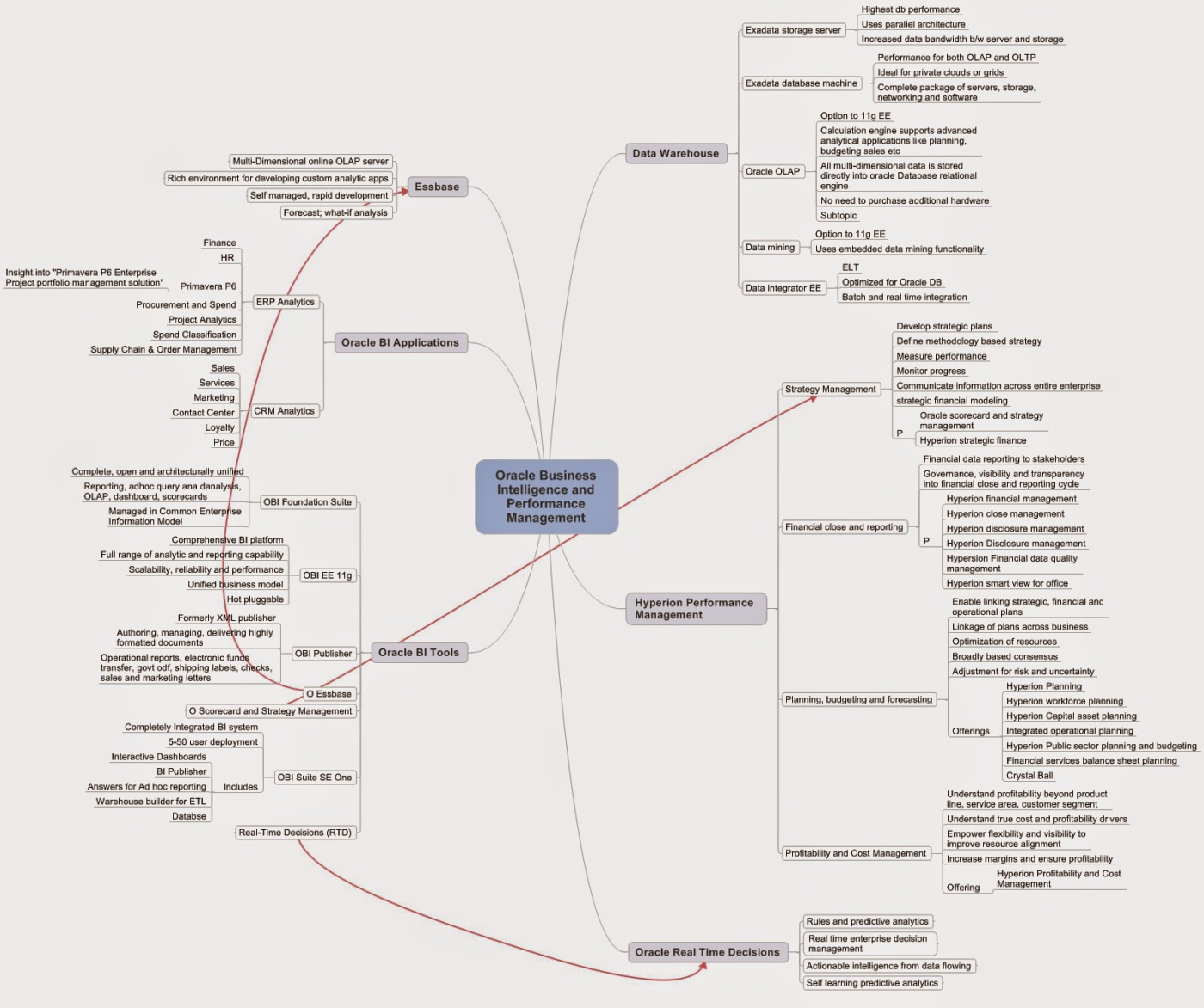
For sake of my understanding, I have created a Mind Map and it keep it easy for me to browse or show it my clients while working on Ascent (BI readiness), a Datavibes service.

(Images below can be clicked for actual-size display for readability)

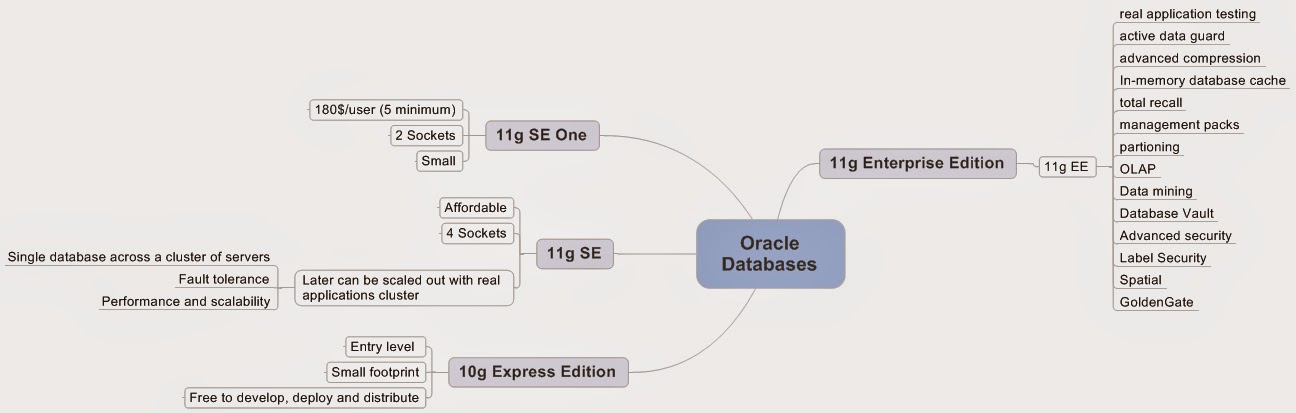
Oracle Databases

Oracle Solution Stack

Oracle Business Intelligence and Performance Management offerings


Do not forget to check our my last post on famous Gartner's Magic Quadrant on BI vendors for Oracle positioning.

IBM Business Analytics (Cognos and SPSS) |


IBM Business Analytics (Cognos and SPSS)

IBM with the acquisition of Cognos (Jan 2008) and SPSS (July 2009) has definitely built a nice and a complete stack on BI offerings. They are on top in Gartner's famous Magic Quadrant for completeness of vision and right below Microsoft, Oracle and Microstrategy for their ability to execute.

Below is a easy-to-read-and-understand chart on IBM's Business Analytics products. Image below can be clicked to full-size preview.

IBM Business Analytics

(Click on image for full screen preview)

IBM Cognos

(Click on image for full screen preview)

IBM SPSS

(Click on image for full screen preview)

Do not forget to check out Oracle's solution stack in my last blog. Please comment and let me know if you [ The readers of the blog :-)] would like explanation or comparison on any of their products.

Amazon Forest Becoming Less of a Climate Change Safety Net


http://ift.tt/1Hu0ohx By JUSTIN GILLIS from NYT Science

Measurements and Menopause


http://ift.tt/1OrPNp7 By C. CLAIBORNE RAY from NYT Science

Science Museums Urged to Cut Ties With Kochs


http://ift.tt/1FSroFt By JOHN SCHWARTZ from NYT Science

Seeking the Facts on Medical Marijuana


http://ift.tt/1OrPKJW By CLAUDIA DREIFUS from NYT Science

When Science Is Lost in a Legal Maze


http://ift.tt/1EKhDYu By GEORGE JOHNSON from NYT Science

The Waves of the Future May Bend Around Metamaterials


http://ift.tt/1BbDjZH By JOHN MARKOFF from NYT Science

Секрет фирмы


«Стартаперы смузи пьют, тыкают в планшетики и не думают о прибыли»

Если кто-то и годится на звание почётного серийного предпринимателя России, то это Олег Тиньков. Он создал и продал сеть бытовой электроники «Техношок», марку пельменей «Дарья», пивоваренную компанию и сеть ресторанов «Тинькофф». Последние 8 лет Тиньков — банкир. Его Тинькофф Банк занимает 55-е место в России по активам и заработал в прошлом году 3,4 млрд рублей чистой прибыли (по МСФО). Впрочем, Тиньков не принимает активного участия в управлении своей компанией, много путешествует, катается на велосипеде и троллит стартаперов.

«Сейчас предпринимательства в стране вообще нет»

— Из ваших интервью следует, что самые яркие персоны в российском бизнесе родом из 1990-х, а молодой шпаны не видать.

— Да и нас, бизнесменов, выжило немного, по пальцам рук можно сосчитать. Я имею в виду настоящих бизнесменов, а не олигархов, которые мутят что-то с государством. Если сравнивать с 1990-ми, то сейчас предпринимательства в стране вообще нет. Но это же нормальная ситуация. Мы были голодные и нищие, нам нужно было что-то делать, а сейчас все обеспеченные. Я выступаю 3–4 раза в год перед студентами — мехмат МГУ, физтех и др. Цели у меня рациональные — рекрутировать лучших людей. И я вижу, что студенты очень хорошо одеты, девушки красивые. Но у них нет мотива. Как у моих детей никогда не будет мотива работать так же, как я. Мой сын дружит с сыном Миши Фридмана. У них даже какой-то совместный бизнес в интернете, но это всё смешно и наивно. Это детский сад. Потому что нужен мощный мотив.

Я помню своё общежитие на Васильевском острове — у нас предпринимательством занималась половина студентов. Что-то продавали, что-то покупали. Сейчас крутится куда меньше молодых людей. Жизнь не заставляет, родители помогают. Московские мажоры не хотят работать.

— По этой логике кризис мотивирует людей заняться бизнесом?

— Если ситуация ухудшится, то может быть. Но пока и кризиса-то нет особого. Все ухудшилось только в сравнении с жирными годами. Я не вижу страданий больших. Подумаешь, рубль упал в два раза — на Украине валюта упала в четыре раза! Может, кстати, там будет бум предпринимательства в ближайшие годы. А мы меньше будем сапог покупать. Не пять пар будет у студентки, а две. Ничего трагического не происходит. У нас более 5 млн клиентов. Все платят, деньги есть. Обороты растут по картам. Нет трагедий.

— Как же — вот ваша годовая отчётность: доля неработающих кредитов (NPL) выросла с 7% до 14,5%. Это уже высокий уровень. Падает прибыль и темпы роста бизнеса…

— Ну я вижу, что вы не компетентны про банк разговаривать. Мы завтра все долги эти продадим и NPL будет 0, только нам это экономически нецелесообразно, так как нам выгоднее держать их на балансе. NPL не отражает ничего. Журналисты всё время выхватывают цифры и нагоняют негатив. Мне со всего мира коллеги звонят — крутая отчётность, а журналисты только мочат. У конкурентов убытки утроились, а у нас упала чистая прибыль, какой кошмар. Вас в МГУ учат на журфаке, что якобы негатив продаёт, но парадокс в том, что все российские деловые СМИ теряют деньги. Западные СМИ тоже любят негатив, но они хотя бы видят свет в конце тоннеля и деньги зарабатывают. Наши мочат из любви к искусству. И в итоге общество зомбируется — всё говно, вокруг предатели, вот и Борю Немцова застрелили из-за этого. Я считаю, СМИ виноваты в том, что мы живём в этой жопе не меньше политиков, силовиков и предпринимателей. СМИ превращают людей в быдло, а сейчас нужен позитив.

— Я на журфаке МГУ не учился и за коллег отвечать не могу. Окей, сформулирую по-другому, без NPL. До недавнего времени потребление в стране активно росло — во много благодаря заёмным деньгам. Сейчас этот рост остановился. Какие новые риски появились у банка? Сможет ли он так же быстро расти, как раньше?

— Любой бизнес цикличен. И особенно цикличен банковский розничный бизнес. Мы в самом начале плохого цикла. Ближайшие два года будет плохо. Потом произойдёт очищение системы, люди разберутся с долгами, и начнётся новый рост. Да, сейчас мы не выдаём 100–150 тысяч карточек в месяц, как раньше, выдаём только 40–50 тысяч. Риски начали расти два года назад, а сильно скакнули год назад. Мы одни из немногих, кто был к этому готов. В розничном бизнесе сейчас зарабатывают всего три коммерческих банка — Альфа-Банк, Совкомбанк и мы. А важно только то, зарабатываешь ты деньги или теряешь. Всё остальное — детали. В 2013 году мы заработали $180 млн чистой прибыли, в 2014-м — $90 млн, и в 2015-м мы будем прибыльными. И что-то мне подсказывает, что мы в этом году будем единственным негосударственным прибыльным розничным банком в России. Мне интересно, когда бизнес зарабатывает и платит дивиденды. Я лично получил за прошлый год $30 млн. Вот это я понимаю, бизнес.

«Трудно на технологическом уровне бороться с серостью»

— Более выгодных вариантов, чем банковский депозит, для инвестирования вы не нашли?

—Я вообще не готов во что-то инвестировать, никогда этого не делал и не собираюсь. Я не умею быть партнёром. Могу только купить 100% компании и предложить основателям работу. Иногда это полезно — поработать предпринимателем, чтобы стать хорошим управленцем. Недавно, например, собирался купить Ubank и «Штрафы ГИБДД». Но они захотели слишком много денег. Напрасно. Сейчас рынок плохой, многие сыпятся. Может, в ближайшее время кого-то и купим или подберём.

Важный момент — я не хочу рассредоточиваться. Потому что фокус — это очень важно. Напишите крупно, чтобы все поняли. Вот пример Ноготкова. Причин его краха много, но главная — что он не фокусировался на одном бизнесе. У него было слишком много увлечений, и всё это плачевно закончилось. Таких примеров много.

— Вы же и пивом, и пельменями, и электроникой занимались.

— Действительно, я один из немногих предпринимателей в этой стране, кто построил несколько совершенно разных бизнесов. Я этим горжусь, это же говорит о таланте определённом. Мне интересно каждый раз делать что-то новое, а не копировать собственные проданные проекты. Но при этом я всегда фокусировался на каждом проекте. Никогда параллельно не делал бизнесы, а всегда один за другим.

— Есть какие-то принципы, которые объединяют все ваши проекты?

— Главный принцип — клиент всегда прав. Я пляшу всегда от печки, от клиента. Пытаюсь найти новые неудовлетворённые потребности и их удовлетворить. Если это электроника, то ассортимент «Берёзки» можно было купить не за доллары, а за рубли. Если это пельмени, то их можно было домой в метро довезти, и они не слипались, как советские. Если пиво, то нефильтрованное и с откручивающейся крышкой, не надо зубами открывать. Если банкинг, то онлайн, без отделений и очередей. Находим нишу и начинаем её развивать.

— Тем не менее вы всегда вторгались в ниши, где уже были сильные конкуренты.

— Я про это вообще не думал, если честно. Я смотрел на ниши и возможности. Хороший предприниматель видит то, что другие не замечают. Например, сейчас я вижу, что в страховании нет сильного интернет-игрока. Поэтому занимаюсь «Тинькофф Страхованием». Я не знаю, почему другие туда не идут. Они слепые, глухие или что?

— Intouch идёт в онлайн-страхование.

— Ну идёт. Но мы быстро разберёмся с ними. Есть ещё «Ренессанс», но что это за компания. 10 лет теряет деньги. Что это за бизнес? Смешно. Я не могу назвать их бизнесменами. Конечно, совсем не смотреть на конкурентов — это шапкозакидательство. Когда я шёл в пельмени, на рынке была огромная компания «Талосто», настоящий монстр. Они производили тысячу тонн пельменей в день, а мы станочек купили на 200 кг. Но через три года мы производили уже 3 000 тонн, а они так на тысяче и остановились. Лоб в лоб нельзя, конечно, конкурировать. Нельзя в лоб идти на Сбербанк, на «Балтику», на «Тинькофф». Нужно искать обходные пути.

— Но вы же пошли в лоб на «Русский стандарт»?

— Нет, мы с ними не конкурировали, у нас разные бизнес-модели. И я ни одного человека специально у них не сманивал. Когда я строил команду, первые 30 человек нанимал сам. И строчка «Русский стандарт» в резюме — это был стоп-фактор. По эмоциональным причинам: мне не хотелось, чтобы Рустам Тарико позвонил и спросил, чего я людей переманиваю. И по рациональным: мне никогда не хотелось строить ещё один «Русский стандарт».

— А как вы эти ниши ищете? Часто ли ошибаетесь?

— Я очень долго выбираю, по принципу «семь раз отмерь один раз отрежь». Бывает, ошибаюсь. Например, в ситуации с Tinkoff Digital. Этот проект нельзя назвать неудачным, ведь деньги я не потерял. Но и успехом, наверное, тоже не стоит называть. Я думал, платформа RTB (Real Time Bidding — онлайн-аукцион рекламных объявлений — «Секрет»), основанная на Big Data и самых современных технологиях, будет расти. Я считал, что вся медийная реклама в сети уйдёт туда, но этого не произошло. Нет взрывного роста. Сам рынок оказался маловат. Так что нужно ещё и на объём рынка смотреть, выбирая нишу.

Проблема в том, что в России рынок медийной рекламы — мутный и незрелый. Это «серая» зона, во многом построенная на откатах, отношениях между людьми, этих вась-вась. Трудно на технологическом уровне бороться с серостью. Нам ещё повезло — мы эту технологию смогли в банк встроить. Если зайдёте на наш сайт пару раз, то будете видеть нашу рекламу повсюду.

«В этой улыбке было много дикости»

—Я посмотрел котировки вашего банка на LSE: вы размещались по $17,5 за депозитарную расписку GDR, а сейчас они стоят дешевле $3. Почему так сильно упала капитализация?

— Так иди купи пока дёшево… А у кого капитализация не упала? У Сбербанка, «Яндекса», Mail.Ru — все 70–80% потеряли. Только герой нашего времени Сергей Галицкий со своим «Магнитом» так сильно не падает. Это страна упала. Какие к нам вопросы?

Преодолевая тернии и звёзды, мы разместились в последнем квартале 2013 года. И тут же начался кризис перекредитования. Люди нахапали кредитов и начали всё медленнее их возвращать. Плюс в Госдуме появилась дурацкая поправка, которую пресса растиражировала (в ноябре 2013 года в Госдуме появился законопроект, который можно было трактовать как запрет на выдачу кредитов дистанционно, но вскоре оказалось, что депутаты пропустили союз «или» по ошибке, — «Секрет»).

Западные инвесторы вроде хотят инвестировать в российский бизнес, но если что-то идёт не так, то сразу продают акции. Ситуация понятная и объяснимая. Я им в глаза говорил: вот вы купили акции по $17, через месяц продаёте за $6. Вы чего делаете? Ну, такие правила фонда, отвечали мне менеджеры: если акция падает более чем на 20% в день, её обязаны сбросить, иначе менеджер фонда потеряет работу. Вот и начался обвал. А потом подоспела Украина, геополитика, и мы падали вместе со всеми.

— Что ощущает человек, который из-за какой-то грамматической ошибки в каком-то законопроекте теряет сотни миллионов долларов?

— Я миллиард долларов потерял. Вышел сюда в офис, смотрю — все сотрудники на Bloomberg сидят, деньги считают. Ребята, говорю, запомните этот день, вы видите человека, который за 20 минут потерял миллиард долларов. И улыбаюсь. В этой улыбке было много дикости. Я же человек, а не черепаха. Суицидальных мыслей, конечно, не было, но было неприятно. И вопрос не в только миллиарде, он же всё-таки виртуальный, а в тупости. Один запятую не там поставил, другая не так написала об этом в газете, а третий стал акции продавать. Это абсурд.

— Вы о делистинге даже говорили…

— Если будет экономически выгодно — можем провести, у меня есть на это деньги, но пока такой необходимости нет. Мы и сейчас торгуемся за один капитал, а другие российские публичные банки за 0,3–0,5. Банк всё-таки стоит в два раза дороже конкурентов. Так что пока не сдались. Уверены, что рынок нас ещё оценит.

— Когда?

— Это проблема России — всем всё надо завтра. Чтобы заработать свой миллиард, я 25 лет занимался бизнесом. А у нас только вылупятся люди из Сколково, уже хотят квартиру в Москва-Сити и Tesla. Социальный лифт им подавай. Идите на лестничную клетку и пешком поднимайтесь. Работать надо, а не лифт искать. В чём проблема Сергея Полонского и многих других? Они быстро выросли и быстро всё потеряли. Многие от быстрых денег сходят с ума. Я зарабатывал медленно и спокойно. Президент Тинькофф Банка Оливер Хьюз — англичанин. Он говорит, ребята, спокойно, всё хорошо, через 5 лет акции вернутся на уровень IPO. Это англосаксонское мышление. А нам надо всё через год, максимум — через три.

«Развели инвесторов, бабло просрали, подняли новый раунд и так до бесконечности»

— Ваша переписка-перепалка с поддержкой «Рокетбанка» про пули и коворкинг стала хитом Рунета. Зачем вы делаете промо небольшому стартапу?

— Я люблю стартаперов. Я же апологет предпринимательства. Помогаю молодым ребятам, героям пою славу. Обычно я это делаю, когда нечем заняться. А времени у меня свободного много. Твиттер — это развлечение. Сижу, делать нечего, давай потроллю. Может клиентов у «Рокетбанка» прибавится, продлю им агонию на месяц. Хотя, конечно, они не выживут. Дай бог кто-нибудь купит. Для меня они как дети малые, я им помогаю.

— Почему не выживут?

— У них очень дорогой customer service, нет правильных продуктов и доходов. Есть банк «Интеркоммерц», есть клиенты — а приложение «Рокетбанк» где-то посередине. Живут на комиссию 2% от Mastercard, но что-то ещё банк забирает. На чем они зарабатывают, я не понимаю. Эта модель обречена. У них 6 000 клиентов за два года, а у нас бывают дни, когда мы выпускам за сутки 3 000 карт. Понимаешь масштаб. Единственный вариант — какой-нибудь банк решит создать продукт для хипстеров и купит их. Но они уже столько денег сожгли, что нет смысла покупать. Жалко их. Для меня «Рокетбанк» — это не конкретный стартап, а обобщённый образ, пример того, как нельзя делать бизнес. Такие проекты живут от раунда к раунду. Развели инвесторов, бабло просрали, подняли новый раунд и так до бесконечности. А сейчас нельзя так жить. Или нужно делать стартап на свои деньги, либо в супер-нише, где можно сразу зарабатывать чистую прибыль. В массе же своей стартаперы привлекают инвестиции, снимают новый офис, смузи пьют в коворкинге, тыкают в планшетики свои. Никто не думает про прибыль и экономическую целесообразность. Зачем нам деньги зарабатывать, мы компанию строим. Это не предпринимательство, а говно какое-то. Инвестиционные деньги развращают. Когда мы были молодые, у нас не было бизнес-ангелов, фондов, раундов. Но мы не жаловались.

— Стоп, а как же Facebook, Twitter и другие большие венчурные истории. Многие инновационные компании прекрасно развиваются, хотя долгое время не зарабатывали прибыль.

— В США модель другая. Там есть фондовый рынок. А в России его нет. Самый большой источник капитала в мире — фондовый рынок. Не инвестфонды, и не облигации. Поэтому Twitter может себе позволить ни копейки не зарабатывать и иметь миллиардную капитализацию. Поэтому бизнес-модели Apple, Tesla, Microsoft у нас не работают. Если хотите создать Apple, садитесь в самолёт и летите в США. Там есть экосистема, а у нас её нет. Есть несколько фондов, но эти люди сумасшедшие. У нас имеет право на жизнь модель зарабатывания денег, но не роста капитализации.

— Почему вас судьба стартаперов так волнует?

— Вопрос же во всей индустрии этой. Молодые люди сидят в соцсетях, трутся вокруг моих аккаунтов. А чем больше сидят, тем меньше делают. Я могу себе позволить тратить время на соцсети, я же владелец банка, а они нет. Их стартапы не удовлетворяют потребителей, не строят новое, а осваивают деньги и живут от инвестора к инвестору.

Назовём это агрессивный позитивизм. Я реально хочу помочь — ребята за формой потеряли содержание. Всё выглядит красиво, круто, но если спросить, а для кого вы это делаете? Зачем? Они задумаются. Все западные фонды «позакрывали» Россию. Российские — все свои деньги раздали. В государственные инвестиции я тоже не верю. Всё, единственный шанс выжить — начать деньги зарабатывать.

— Многие пытаются сейчас стартовать сразу за границей. А у вас нет желания построить международный бизнес, как у соседа по бизнес-центру Евгения Касперского?

— Нет, никогда. Касперский 20 лет в этой теме. У меня времени уже не остаётся на международные проекты. Дети пусть делают. Я старый, я не готов. Это очень сложные рынки. Касперский — исключение, подтверждающее правило. У меня вызывает смех, когда люди летят в Калифорнию открывать офис, не имея ни продукта, ни продаж в России. Они не понимают, что уровень конкуренции там на порядок выше. Я в США шесть лет жил, пиво продавал, потерял деньги. Стартаперы наши как космонавты, совсем тормозов нет.

— Так что, Тинькофф Банк — это навсегда?

—Почему навсегда? Может, завтра ваш Мамут (Александр Мамут, СЕО и совладелец Rambler & Сo, — «Секрет») решит не только лучшее медиа о бизнесе сделать, но и построить лучший онлайн-банк. И придёт ко мне. Потому что больше некуда идти. Если предложит $2 млрд, я, наверное, соглашусь. Значит, не навсегда. А дальше в космос, вслед за Полонским.

Фотографии: Юрий Чичков/«Секрет фирмы»